
IT Observability : What, Why and How ?
The importance of maintaining system reliability and performance cannot be overstated. This necessity gave birth to the concept of IT observability, a holistic approach aimed at ensuring systems are not just monitored but fully understood. IT observability transcends traditional monitoring by enabling teams to analyze deep into their systems to uncover underlying issues before they escalate into critical problems. Let’s explore the definition of IT observability, its components, and its purpose in modern IT environments.

I. What is IT Observability?
At its core, IT observability is about gaining the insight needed to understand the internal state of systems through the data they produce. It's a methodological shift from merely reacting to issues as they occur (monitoring) to proactively analyzing and predicting potential system failures and performance bottlenecks. Observability allows IT teams to answer not just when and where something happened, but also why it happened, facilitating a more effective and efficient response to incidents.
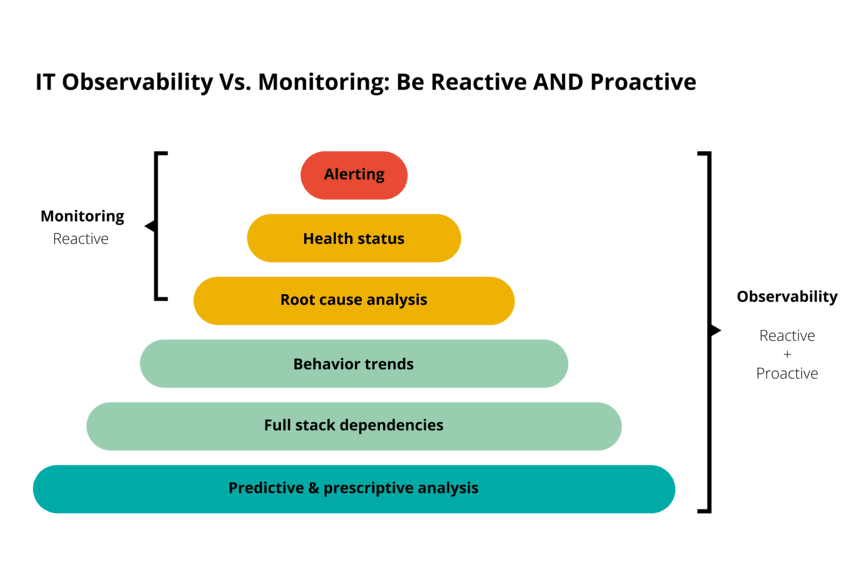
IT observability is built on three fundamental pillars: logs, metrics, and traces, often called the "golden signals".
- Logs: These are detailed, timestamped records of events that have occurred within a system. Logs are invaluable for debugging, providing a historical account of actions and changes.
- Metrics: These quantitative measurements capture various aspects of system performance, such as CPU usage, memory consumption, and response times. Metrics are crucial for trend analysis and capacity planning, offering a snapshot of system health.
- Traces: Tracing involves tracking individual requests as they traverse through the different components of a system. It is essential for understanding the flow of transactions and identifying bottlenecks within complex, distributed systems.
II. Why do you need IT Observability?
In the era of cloud computing and microservices, IT environments have become more complex and distributed, making traditional monitoring techniques insufficient. Observability addresses this challenge by providing a comprehensive view of system health, performance, and behavior. It empowers IT teams to manage and optimize their infrastructure proactively, ensuring high availability and minimal downtime. Furthermore, observability facilitates a culture of continuous improvement, where insights derived from data lead to better decision-making and system enhancements.
III. How to implement IT Observability?
Implementing IT observability requires a strategic approach that encompasses tool selection, data analysis, and team training. Organizations should invest in observability platforms that integrate seamlessly with their existing infrastructure and support the collection and analysis of logs, metrics, and traces. Additionally, fostering a culture that values data-driven decision-making is crucial. IT teams must be trained to interpret observability data effectively and apply those insights to improve system resilience and performance.
In the context of implementing IT observability, the Zetaly Data Platform emerges as a revolutionary solution designed to empower organizations in their journey toward achieving unparalleled system transparency and operational efficiency. Zetaly specializes in harnessing the power of observability, integrating seamlessly with your IT infrastructure to collect, enrich, and expose logs, metrics, and traces. Its sophisticated analytics engine transforms raw data into actionable insights, enabling IT teams to predict and preempt potential system issues with precision. By leveraging Zetaly's comprehensive observability suite, organizations can not only enhance their IT system's resilience and performance but also streamline their decision-making processes.
IT observability represents a significant advancement in how organizations manage and understand their IT environments. By embracing observability, businesses can achieve greater system transparency, enhance operational efficiency, and reduce the risk of downtime. As IT landscapes continue to grow in complexity, the importance of observability in ensuring system reliability and performance cannot be overstated. It's not just about monitoring what's happening; it's about understanding your systems at a profound level to ensure they operate at their best.